Bravais lattices
Note · 12 November 2026 · Physics › Solid state physics
Crystals form periodic latices, a reasonable question to ask is whether there is a finite number of them. Obviously one can always change the atom spacing but that’s not the question, the question is how many ways are there to pack atoms together. Mathematically, this can be answered by considering rotations which map the lattice onto itself and it turns out there are only 5 unique lattice arrangements in a plane and 14 in space.
Drag the two arrows in the figure. Any two arrows that end on atoms give a tile that repeats. A tile three atoms big is wasteful, and two parallel arrows give no tile at all. The smallest tile holds one atom. Its shape changes with the arrows you pick, but the pattern of points behind it does not. That pattern is the Bravais lattice. On the square surface it is square, on the rectangular one rectangular.
How the count was found
- 1784 · Haüy’s bricks. Crystals grow with flat faces that meet at fixed angles, and they split along flat planes. René Just Haüy explained this by building a crystal from identical small bricks. Long before anyone could see atoms, the brick picture made the crystal a geometry problem: in how many ways can one unit repeat through space?
- 1842–1848 · Frankenheim and Bravais. Moritz Frankenheim counted 15 lattices in 1842. Auguste Bravais showed in 1848 that two of them are the same lattice, which left the fourteen that carry his name. His memoir appeared in 1850 (Bravais 1850; Hahn 2006).
- 1891 · The 230 space groups. A lattice counts the ways to repeat a point. Real crystals repeat a group of atoms, which can have less symmetry than its lattice. Fedorov and Schoenflies counted those patterns independently and found 230 space groups.
- 1912 · X-ray diffraction. All of this stayed a hypothesis until X-rays passed through a crystal and produced sharp spots (see X-ray crystallography). From then on, the lattice defined what a crystal was.
- 1984 · Quasicrystals. A crystal with five-fold symmetry broke that definition, because no lattice allows a five-fold rotation (see Where the lattice idea breaks).
Step 1: two vectors generate the lattice
A Bravais lattice is the infinite set of points where the primitive vectors are fixed, independent vectors (two of them in the plane). Every point of a Bravais lattice sees exactly the same surroundings, in the same orientation (Hahn 2006). The marked point in the figure is .
The parallelogram (in space, the parallelepiped) spanned by the vectors is a primitive cell. It holds exactly one lattice point, and its copies shifted by every fill space without gaps or overlaps. The choice is not unique. Replace b by b + a or by b − 2a: the cell shears, but its area and the lattice stay the same. Watch the vector between whole values of k. It leaves the lattice, so only whole k give a valid cell.
Step 2: only some rotations fit a lattice
The crystallographic restriction says that a lattice can only have 1-, 2-, 3-, 4- or 6-fold rotation axes (Hahn 2006). In the figure, a quarter turn maps the square lattice onto itself, and a sixth of a turn maps the hexagonal one. A fifth of a turn maps no lattice onto itself, and neither does an eighth.
The proof takes three steps:
- A rotation that maps the lattice onto itself sends each primitive vector to an integer combination of primitive vectors. In the lattice basis its matrix therefore contains only integers, and so does its trace (the sum of the diagonal entries).
- The trace does not depend on the basis. In an ordinary Cartesian basis, a rotation by has trace in the plane, or in space.
- So must be an integer between and . That leaves only : the number line on the right of the figure.
The same result shows in a tiling. Squares, triangles and hexagons cover a floor with no gaps, but regular pentagons always leave gaps.
Step 3: five lattices in the plane
In two dimensions the allowed rotations sort lattice shapes into four lattice systems: oblique, rectangular, square and hexagonal. Each step from oblique adds a constraint: a right angle, then equal sides, or equal sides at 120°.
A rectangular lattice can also carry an extra point at the centre of each rectangle. That gives a genuinely new lattice, the centred rectangular one, whose primitive cell is a rhombus. The other systems gain nothing from a centre point. A centred square, for example, is just a smaller square lattice turned by 45°.
So the plane has five Bravais lattices (Hahn 2006). The bubble raft in Dislocation theory shows two of them: the triangular raft is the hexagonal lattice, and the model square crystal is the square lattice.
Step 4: fourteen lattices in space
In three dimensions the allowed rotations give seven lattice systems:
- triclinic: no constraint on lengths or angles;
- monoclinic: one oblique angle, the other two at 90°;
- orthorhombic: three unequal axes at right angles;
- tetragonal: two equal axes and one different, all at right angles;
- rhombohedral: three equal axes with equal oblique angles;
- hexagonal: two equal axes at 120°, the third perpendicular to both;
- cubic: three equal axes at right angles.
Each system can also carry extra lattice points inside its conventional cell. These centrings are base-centred (C), body-centred (I) and face-centred (F). They add a point on one pair of opposite faces, a point at the cell centre, or a point on every face. The plain lattice is called primitive (P).
Seven systems and four centrings would give 28 combinations, but most of them are not new. The figure crosses out the ones that fail and says why:
- Some only describe an existing lattice with a smaller cell. Base-centred tetragonal is primitive tetragonal, and face-centred tetragonal is body-centred tetragonal.
- Some describe the same lattice with other axes. Body-centred monoclinic is base-centred monoclinic.
- Some break the symmetry of their system. A base centring on a cube makes one axis special, so the lattice is no longer cubic.
What remains is fourteen Bravais lattices (Hahn 2006). The conventional cell is the cell that shows the symmetry best, and it can hold more than one lattice point. The face-centred cubic cube holds four, and the body-centred cubic cube holds two. Each lattice also has a primitive cell with only one.
Two lattices carry most of structural metallurgy. Copper, aluminium and nickel are face-centred cubic, and α-iron is body-centred cubic. The difference decides how the metals slip (see Dislocation theory and Crystal plasticity).
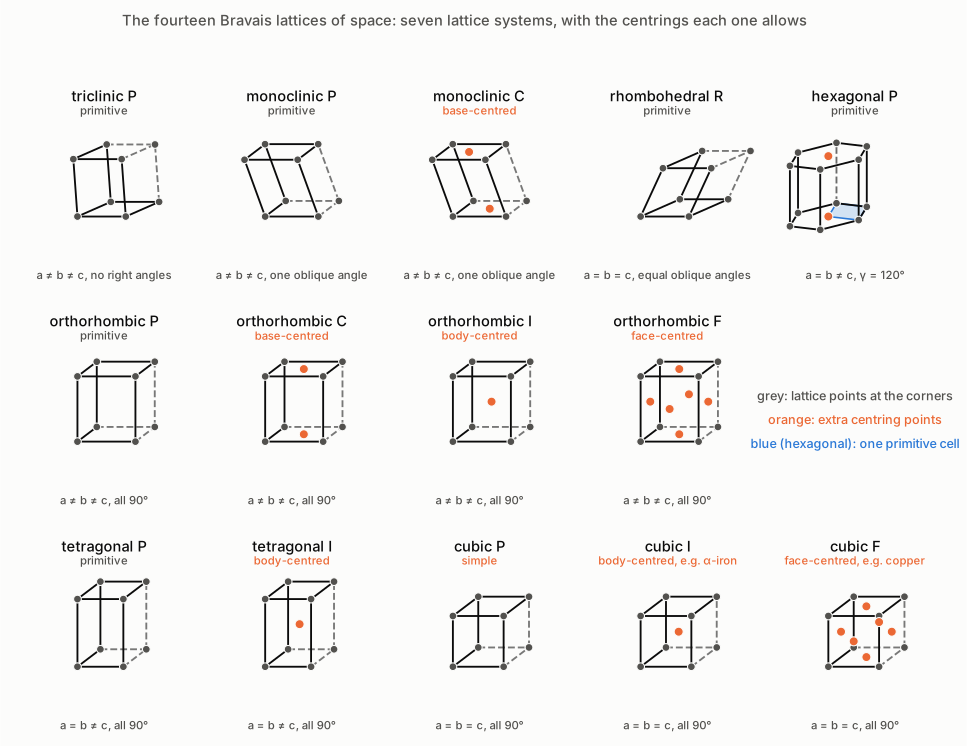
The count changes with dimension. A line has one Bravais lattice, the plane five, space fourteen and four-dimensional space 64 (Hahn 2006).
Step 5: a lattice plus a basis is a crystal
A Bravais lattice describes only how a crystal repeats. A real crystal places a group of atoms, the basis, at every lattice point, and the crystal structure is the lattice and the basis together. In the figure the lattice is hexagonal and the basis is two atoms. With the second atom at t = 0 the crystal is the plain lattice. At t = 0.15 it is a crystal of pairs. At t = 1/3 it is the honeycomb of graphene. Every honeycomb atom has three neighbours, but the blue and orange atoms see them in opposite directions. So the honeycomb is not a Bravais lattice by itself.
Many familiar structures are, like the honeycomb, a lattice with a basis:
- diamond and silicon are the face-centred cubic lattice with a two-atom basis;
- hexagonal close-packed metals such as magnesium, titanium and zinc are the hexagonal lattice with a two-atom basis;
- graphene is the two-dimensional hexagonal lattice with a two-atom basis.
A basis can have less symmetry than its lattice, so the full classification counts the symmetry groups of whole crystal patterns. There are 32 crystallographic point groups (the rotation and mirror symmetries of a crystal about a point) and 230 space groups in three dimensions. The plane has 17 space groups, called the wallpaper groups (Hahn 2006). The 14 lattices count the ways to repeat a point in space, and the 230 space groups count the ways to repeat a pattern. A crystal structure belongs to exactly one of each.
Where the lattice idea breaks: quasicrystals
- In 1984 Shechtman and co-workers reported a rapidly cooled aluminium–manganese alloy whose diffraction pattern had sharp spots and icosahedral symmetry, with five-fold axes (Shechtman et al. 1984). Sharp spots meant long-range order, but Step 2 forbids five-fold rotations in any lattice.
- The material was ordered without being periodic. It was a quasicrystal, the three-dimensional relative of the Penrose tiling. See Quasicrystals.
- The International Union of Crystallography then redefined a crystal. A crystal is now any solid with an essentially discrete diffraction pattern, whether it repeats or not (“Report of the Executive Committee for 1991” 1992). Periodicity, and with it the Bravais lattice, describes most crystals but no longer defines them.
- 💭 Quasicrystals are usually described as a slice through a periodic lattice in a higher dimension, where five-fold rotations are allowed. That would tie the 64 four-dimensional lattices back to real materials.
Links:
- Crystal plasticity — slip systems are the densest planes and shortest vectors of each lattice.
- Dislocation theory — Burgers vectors are lattice translations, and the bubble raft shows two of the five planar lattices.
- Solid state physics — Bloch’s theorem assumes the lattice.
- X-ray crystallography — how the lattice is measured, and the reciprocal lattice behind band structure.
- Quasicrystals — long-range order without a lattice.
- Symmetry and Group theory — space groups are the symmetry groups of crystal patterns.